You’ve sketched the collection, set the price points, and built the line sheet. Now comes the decision that quietly determines your quality ceiling, your margin floor and your reputational risk: who actually knits your cashmere.
Most content about “finding a cashmere supplier” is written for search engines, not for buyers. This guide is the opposite. Below is the due-diligence framework that experienced European production teams actually use — the seven things to verify, the red flags that end relationships early, and the questions worth asking on a first call. Where relevant, we’ll show you how a mill-direct manufacturer answers each point, with real numbers from our own workshop floor.
Why the Supplier Decision Matters More Than the Fibre
Two suppliers can both sell you “Grade A 100% cashmere” and deliver garments that behave completely differently. The fibre is the starting point; everything your customer touches — density, seaming, shape retention, pilling behaviour — is decided by the mill’s equipment, operators and quality culture.
A supplier problem discovered after delivery costs you a season. A supplier problem discovered in due diligence costs you an email. That’s the entire business case for reading this page carefully.
The Due-Diligence Framework: Seven Things to Verify
1. Fibre Origin and Vertical Integration
Ask where the fibre comes from and who controls processing. The premium cashmere belt runs through Inner Mongolia, Tibet and Xinjiang, and the strongest mills are vertically integrated: they run their own washing, carding and top-making, with long-term relationships to fixed herding cooperatives rather than spot-market purchases.
Why it matters: integration is what turns “good fibre” into consistent fibre — the same spec, season after season, not whichever lot was cheapest at auction.
2. Fibre Specifications — Ask for the Numbers
A supplier worth partnering with will state specs in numbers, unprompted. The two that matter most:
- Micron (fineness) — the lower, the softer. Genuine premium cashmere sits in the mid-15s; anything above ~17 microns will feel coarse relative to what the label promises.
- Staple length — the longer, the better the yarn’s strength and pilling resistance.
Also ask whether every incoming lot is batch-tested (length, fineness, short-staple rate, coarse-hair rate, dispersion) and whether retained samples exist so problems can be traced to source. The fineness logic here is identical to what governs cotton quality — the same principle we explain in our guide to cotton yarn counts.
3. Machine Park and Gauge Range
Your collection’s design language is bounded by the supplier’s machine park. Ask for:
- Gauge range. A mill covering 1.5GG to 18GG can knit everything from chunky statement cables to featherlight 18GG layering pieces. A narrow range forces design compromises.
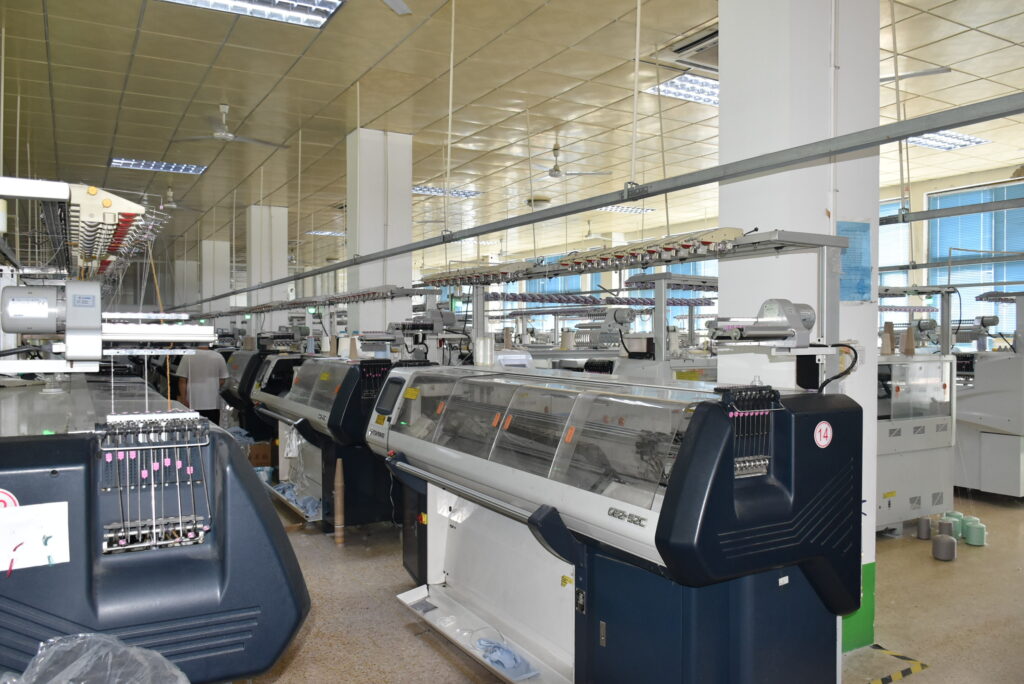
- Machine brands and systems. German-made computerized flat machines (e.g., STOLL) with double- and triple-system configurations handle complex jacquard, intarsia and combined structures efficiently.
- Nameplate capacity. Monthly unit capacity tells you whether they can grow with you — or whether your reordered bestseller will queue behind bigger clients.
4. Construction Capability: Fully-Fashioned, Linking, Hand-Finishing
This is where premium knitwear separates from commodity. Verify the supplier knits shaped panels (fully-fashioned) rather than only cutting from bulk fabric, and ask how garments are joined: automatic linking produces finer, nearly invisible seams, and hand-sewn reinforcement at stress points is what survives years of wear. We cover the full construction logic in how cashmere sweaters are made — it’s worth sending to your design team too.
5. The Quality Control System
“We check quality” is not a system. Listen for stages: panel inspection before assembly, mid-process cross-checks between departments, full-garment inspection under lamps, and final checks before packing. Multi-stage inspection catches defects when they’re still cheap to fix — which is exactly what protects your lead times.
6. MOQ, Sampling and How They Treat Small Orders
A supplier’s flexibility on minimum order quantity tells you how they see emerging brands. Mill-direct partners increasingly offer flexible MOQs alongside free sampling — because today’s 200-piece capsule is next year’s 10,000-piece programme. Ask directly: MOQ per style and per colour, sample cost and lead time, and whether tech packs are welcome at first contact.
7. Compliance and Traceability for the EU Market
Since the EU’s extended producer responsibility (EPR) framework landed, European brands carry accountability for their full supply chain — which makes vague sourcing answers a commercial risk, not just an ethical one. Your supplier should provide batch test reports, retained-sample traceability and clear fibre documentation as standard. For the wider sustainability picture — certifications, grassland standards and what claims you can safely make — see our sustainable cashmere guide.
Red Flags: When to Walk Away
- No numbers. Won’t state micron, staple length or gauge range in figures.
- No batch retention. Cannot trace a finished lot back to its raw material batch.
- “Mill” that can’t show the mill. Trading companies have their role, but if you believe you’re buying mill-direct, ask for a workshop video call or audit — the machine list should match what you’re told.
- One QC checkpoint. Quality is inspected once at the end, or the answer to “how do you control quality?” is a slogan.
- Rigid MOQ, no sampling path. You can’t test the relationship before committing volume.
- Specs that drift. Sample approval and bulk production differ in feel or density — the classic tell of inconsistent fibre sourcing.
Ten Questions Worth Asking on a First Call
- What micron and staple length do you spin as standard?
- Which regions does your fibre come from — own mills or purchased tops?
- What gauge range and machine brands do you run?
- Fully-fashioned, cut-and-sew, or whole-garment — what’s in-house?
- Walk me through your QC stages, panel to packed garment.
- MOQ per style and colour? Sampling cost and lead time?
- Do you retain batch samples, and can I see a test report format?
- What documentation do you provide for EU compliance?
- Which techniques are in-house: intarsia, jacquard, printing, brushed finishes, seamless?
- Who exactly manages my account day to day?
Suppliers who answer these fluently have answered them before. That fluency is itself the signal.
What a Mill-Direct Answer Looks Like: Ours
We’re Beijing Onward Fashion — a specialized knitting mill with 15+ years in natural fibres, focused on cashmere and cashmere blends, serving brand programmes across Europe, the UK and Australia. Here’s our answer to the framework above, with numbers:
| Capability | What we run |
| Fibre origin | Inner Mongolia, Tibet, Xinjiang — own grazing land and fixed herdsman cooperatives |
| Vertical integration | In-house washing mill, carding mill and cashmere-top carding line |
| Standard fibre spec | 30–36 mm staple length, 15.5–16.5 micron fineness |
| Price stability | 5,000-ton raw-material storage — steady year-round pricing |
| Batch control | Every lot tested (length, fineness, short-staple, coarse-hair, dispersion); retained samples trace to source |
| Knitting | 100+ German-imported STOLL computerized flat machines, 1.5GG–18GG, double & triple systems |
| Capacity | 30,000+ units per month |
| Linking & finishing | 100+ automatic linking machines; operators with 3+ years’ experience; hand-sewn reinforcement at stress points |
| Quality control | Six-stage cross-department QC plus full-garment inspection under lamps |
| Techniques in-house | Intarsia, jacquard, printing, brushed cashmere, cable, double-faced, seamless |
| Fibres beyond cashmere | Merino wool, cotton, silk, mohair and blends |
| Colour service | Lab dips and swatches to your colour standards or Pantone references |
| Commercial terms | Flexible MOQ for emerging brands, free samples, factory-direct pricing, one-stop trims customization, custom packing |
Our seamless programme deserves a note: whole-garment knits priced close to conventional jumpers have become one of our strongest sellers with European buyers. Wool coats with full customization — sizes, colours, materials, logos, printing, embroidery — round out the programme for brands extending beyond knitwear.
You can see the finishing standards these capabilities produce across our collection — useful as a benchmark when you brief us on your own specs.
Frequently Asked Questions
Do you work with small or emerging brands?
Yes — deliberately. We offer our most flexible MOQs to businesses starting out, because long-term partnerships begin with first capsules. Free samples and factory-direct pricing apply.
Can you produce seamless (whole-garment) knits? Yes, and at price levels close to conventional linked jumpers. Seamless is one of our hottest categories with European, UK and Australian buyers.
Can you match our colour standards? Yes. We produce lab dips and swatches from your physical colour references or Pantone numbers before bulk dyeing.
What fibres can you work with besides cashmere? Merino wool, cotton, silk, mohair, and blends — all natural fibres, one production partner for mixed programmes.
What compliance documentation do you provide? Batch test reports covering fibre length, fineness, short-staple rate, coarse-hair rate and dispersion, plus retained-sample traceability from garment back to raw-material batch.
What’s your production capacity? Over 30,000 units per month across 1.5GG–18GG — capacity that scales with your reorders, not against them.
Ready to Brief Us? Send Your Tech Pack
Whether you’re a designer with a first capsule, a growing brand scaling a bestseller, or an established label auditing your knitwear programme — the fastest next step is a tech pack or a simple spec sheet. Contact us here, and our team will reply within 24 hours with sampling terms and a development timeline.