One cotton shirt says 40s. Another says 100s—and costs considerably more. Are you paying for something you can actually feel, or just a bigger number?
Here’s the useful answer: higher counts mean finer yarns. Whether they make a better purchase depends on what you want to wear. Let’s break down the difference without turning your shopping trip into a textile exam.
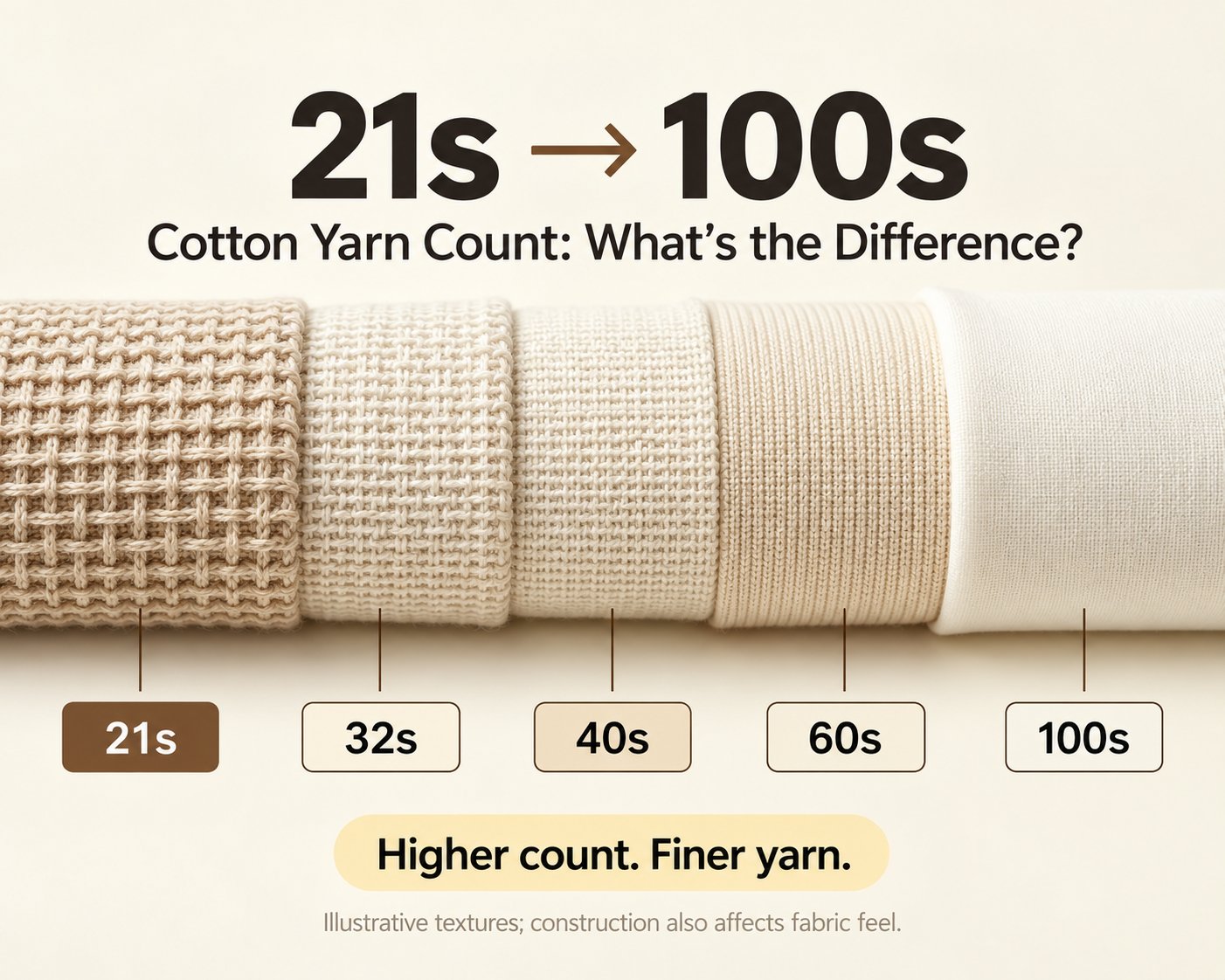
First, What Do Those Numbers Actually Mean?
Cotton yarn count tells you how fine the yarn is.
In the English cotton count system, called Ne, the number measures how many 840-yard lengths of yarn weigh one pound. Higher numbers mean more length for the same weight—and therefore a finer yarn.
Think of making noodles from the same ball of dough:
- Thicker noodles: less total length.
- Thinner noodles: more total length.
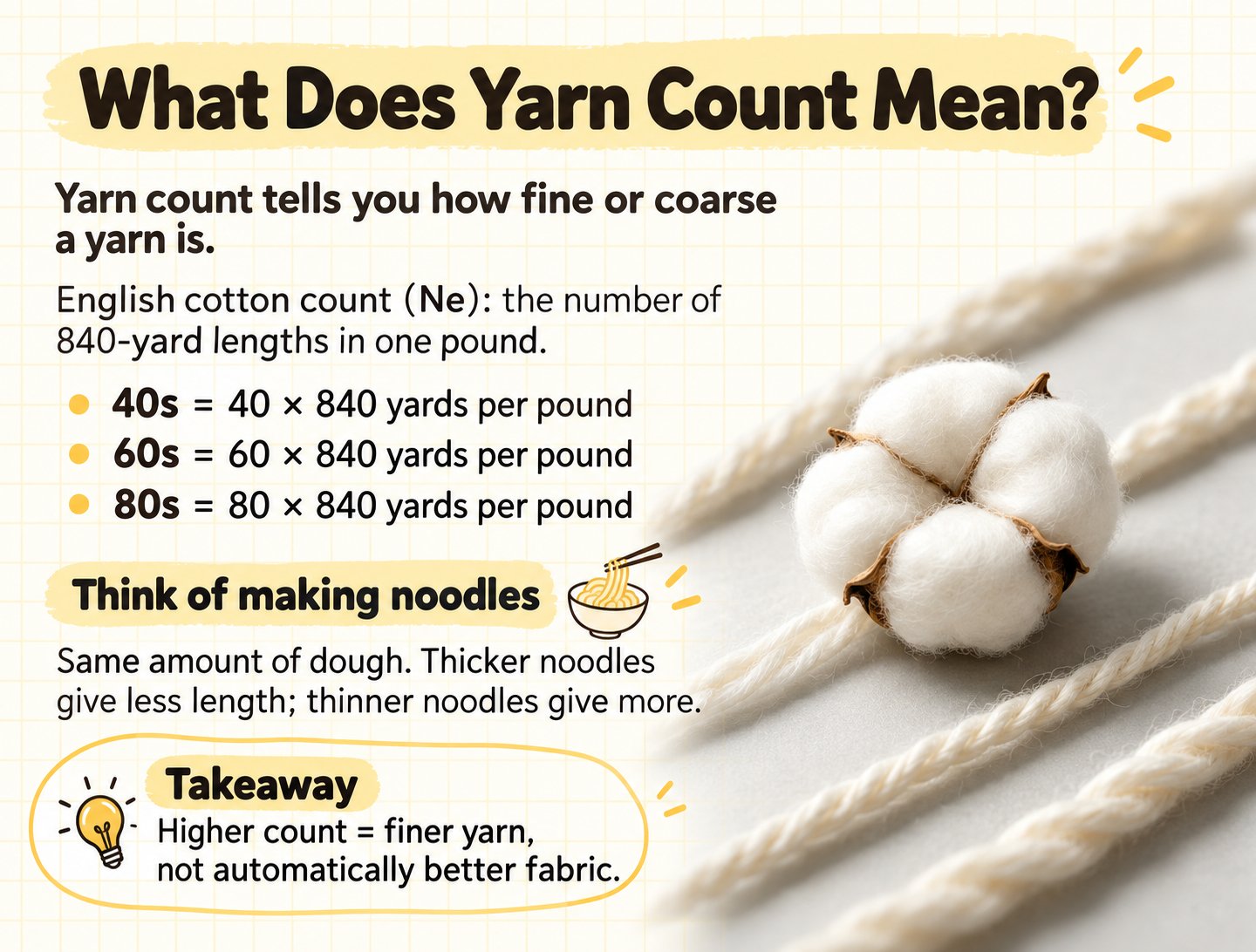
40s is finer than 20s. 80s is finer than 40s. But finer does not automatically mean softer, thicker, or longer-lasting. The finished fabric still has a say.
The Quick Comparison: What Might You Actually Feel?
Imagine running your hand across a substantial cotton tee, a smooth shirt, and a delicate lightweight blouse. Those differences are what shoppers care about. Yarn count helps explain them, but the weave or knit, finishing, and fabric weight help create them.
Use this table as a shopping guide—not a promise printed on a label.
| Count | The general direction* | Worth exploring for | The catch |
|---|---|---|---|
| 21s–32s | More body and noticeable texture | Substantial tees and casual basics | May feel less refined |
| 40s | A balance of fineness and substance | Everyday clothing and bedding | Not automatically soft or opaque |
| 60s | A finer, potentially smoother surface | Refined basics and next-to-skin layers | The upgrade may be subtle |
| 80s | Fine and potentially delicate | Lightweight shirts and refined fabrics | Check transparency and care |
| 100s | Very fine yarn | Fine shirting and special constructions | A bigger number may not improve your experience |
21s–32s: When You Want a T-Shirt With Some Body
You know the cotton tee that holds its shape away from your body rather than falling against every curve? Lower-count yarns can help create that substantial, textured feel.
They’re worth considering if you like casual clothing with a little structure: a solid everyday tee, an easy weekend top, or a fabric that feels satisfying in your hand.
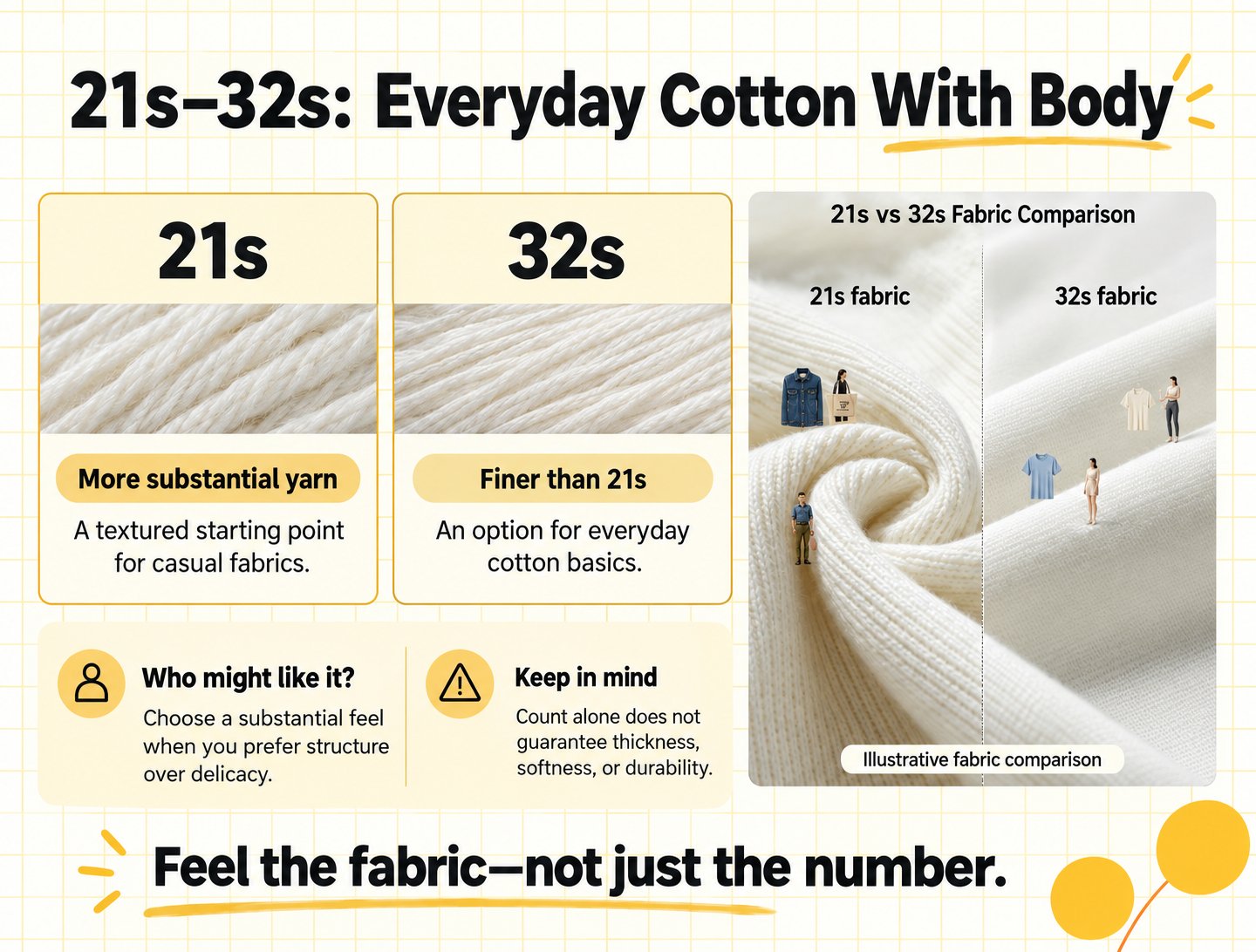
Who might love it: shoppers who prefer substance over a delicate finish.
The honest catch: some fabrics will feel more textured against the skin. But “lower count” does not mean “bad cotton,” and a well-made lower-count tee can be exactly right for the job.
40s: The Everyday Option You Shouldn’t Underestimate
What does 40s cotton mean? It means the yarn has an English cotton count of 40.
In shopping terms, think of it as a useful place to start—not a compromise you need to apologize for.
A well-made 40s cotton fabric can feel comfortable and look neat without being exceptionally delicate. For a tee you wear on repeat, that balance may matter more than having the finest yarn available.
Who might love it: someone looking for comfortable everyday clothing without paying for a specification they may barely notice.
The honest catch: two 40s tees can feel surprisingly different. One may be smooth and substantial; another may feel thin or lose its shape.
The number describes the yarn. It doesn’t grade the whole garment.
60s: The Upgrade Worth Feeling Before You Buy
If 40s is your everyday starting point, 60s is where you may start noticing a more refined surface.
With similar construction and finishing, finer yarn can help the fabric feel smoother and less visibly textured. It may appeal to you if you like basics that feel a little more polished.
Think: a simple top that feels good under a jacket, or a shirt you enjoy wearing directly against your skin.
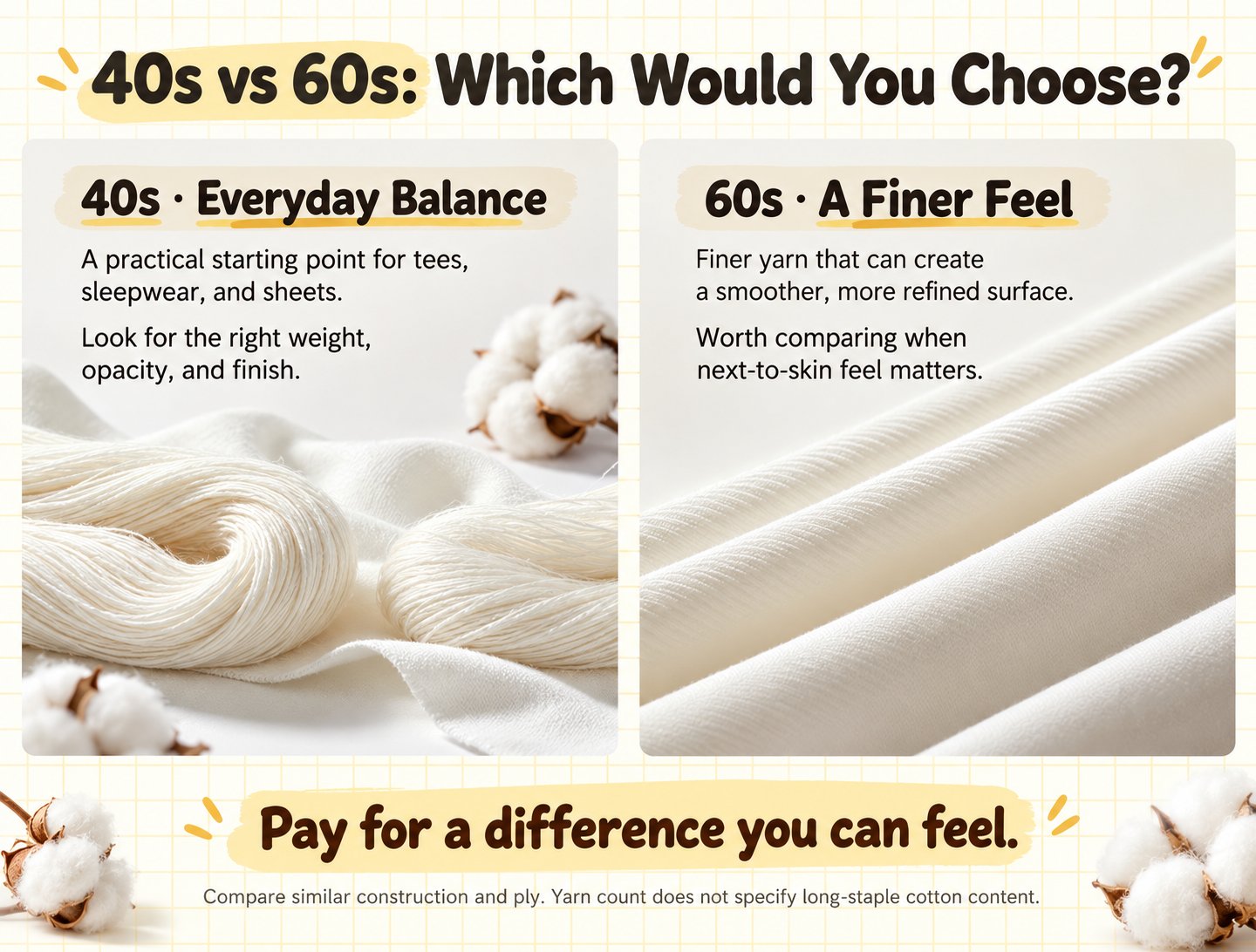
Who might love it: someone who wants a finer feel but still plans to wear the item regularly.
The honest catch: 60s is not a softness guarantee. A crisp woven shirt can feel very different from a soft jersey top, even when both use 60s yarn.
Before paying more, ask yourself: can I feel the improvement—and do I prefer it?
80s: For People Who Notice the Little Things
When comparing 60s vs 80s cotton, the technical difference is straightforward: 80s is finer, assuming the same count system and comparable ply.
The shopping difference is more personal. You may appreciate the finer surface, lighter feel, or delicate drape that an 80s fabric can offer. Or you may try it on and realize you prefer something with more body. Both reactions are reasonable.
Who might love it: someone who enjoys lightweight, refined fabrics and pays attention to how clothing moves.
The honest catch: check light colors against daylight. Depending on the construction and weight, a fine fabric may reveal more than you expected.
Fine can be beautiful. Unexpectedly see-through is less exciting.
100s: A Luxury Detail—or More Than You Need?
100s sounds like the obvious winner.
But before you reach for your wallet, ask: what is the finer yarn doing for this particular fabric?
In a beautifully constructed shirt, it may contribute to a refined surface you genuinely enjoy. In another product, the difference may be less noticeable than the price suggests.
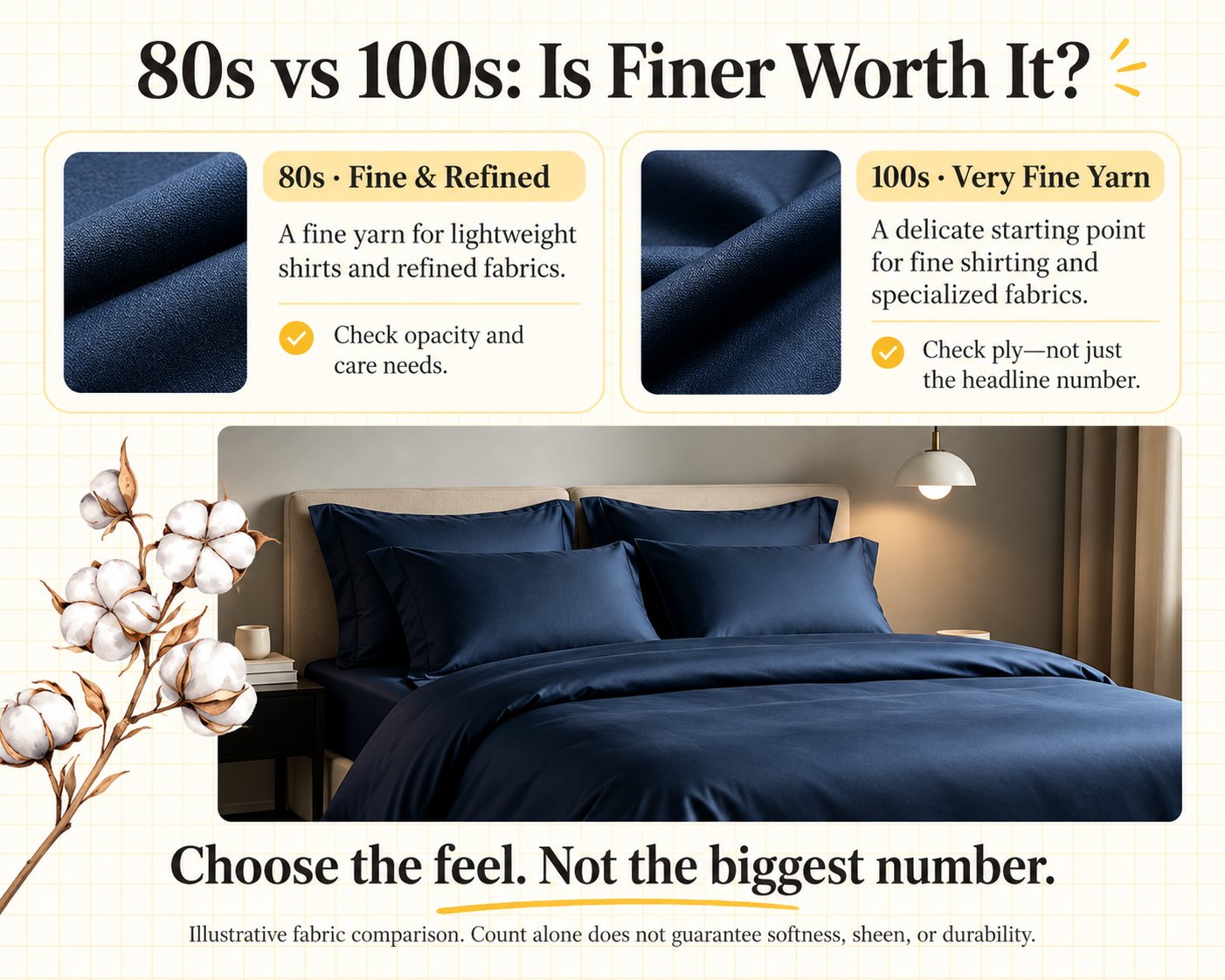
Also check whether the yarn is single or plied. A label saying “100s” leaves part of the story untold.
Who might love it: someone buying for a specific fabric feel, finish, or fine-shirting experience.
The honest catch: you may pay for fineness when what you actually wanted was opacity, easy care, or a substantial feel.
Buy the fabric you love wearing—not the largest number you can afford.
Wait—Is Yarn Count the Same as Thread Count?
No. This is where cotton shopping gets confusing.
- Yarn count: how fine the yarn is.
- Thread count: how many lengthwise and crosswise yarns are present in one square inch of woven fabric.
- Ply: how many individual yarns are twisted together.
So 80s cotton is not an 80-thread-count fabric. And a high thread count on a sheet doesn’t tell you whether you’ll love sleeping on it.
Remember: yarn count describes the yarn; thread count describes the woven arrangement.
So, Which Cotton Count Should You Choose?
“I need an everyday tee.”
Start by comparing 40s options. If you prefer a heavier, more structured feel, try lower-count fabrics too.
Check the neckline, opacity, and how the fabric hangs. Those details will follow you through every wear.
“I want something smoother against my skin.”
Compare similar 40s and 60s fabrics.
Touch the inside—not just the beautifully finished outer surface—and pay attention to the seams.
“I’m buying sheets.”
Decide whether you like a crisp feel or a smoother, more draping one.
Then compare the weave, fabric weight, and care instructions. Don’t let yarn count or thread count make the whole decision for you.
“I want a refined, lightweight shirt.”
Explore 80s and 100s.
Try the garment in good light, check whether you need an underlayer, and decide whether the care requirements fit your life.
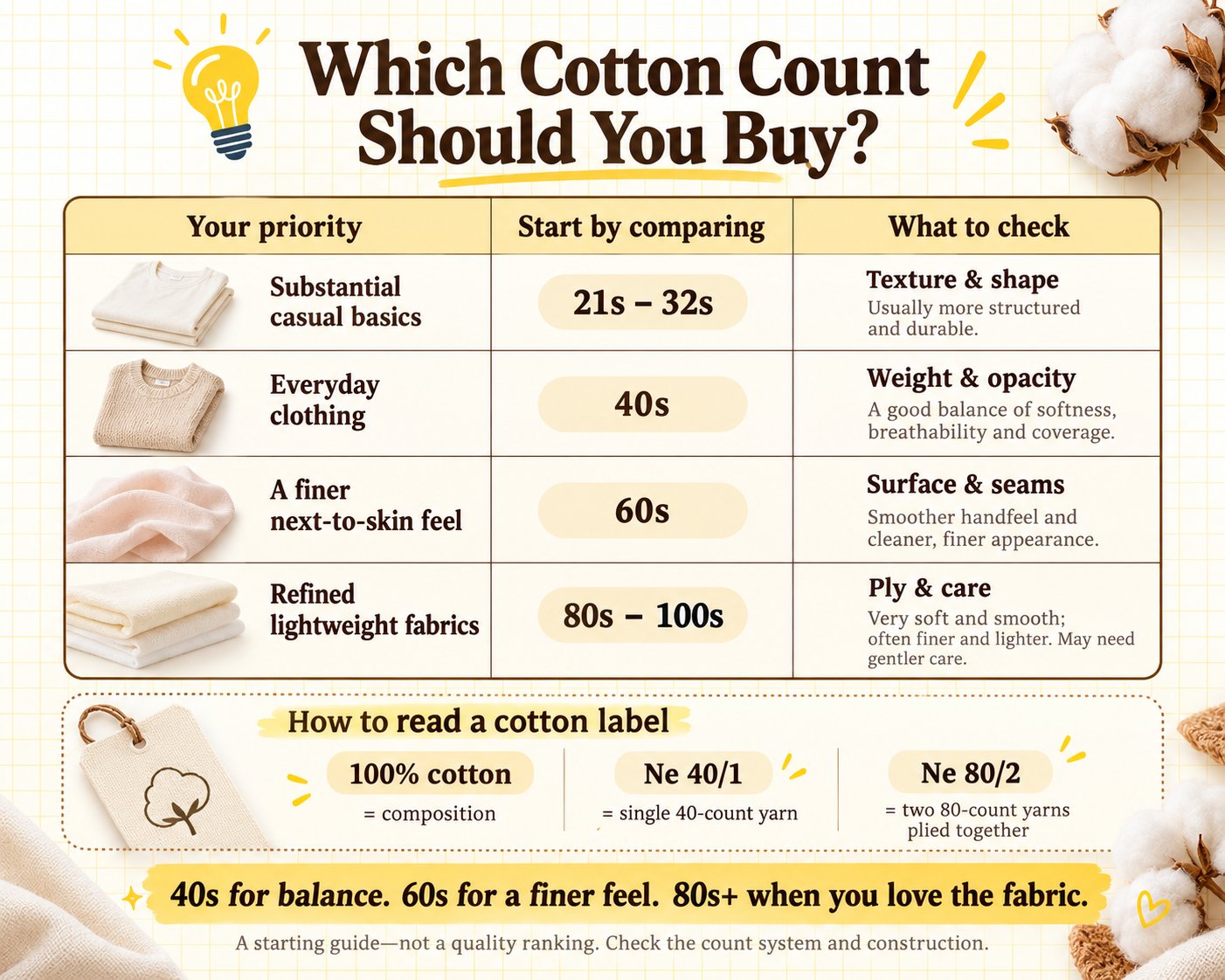
Save this shopping shortcut: 40s for everyday balance. 60s for a finer feel. 80s and above when you love the finished fabric.
Before You Pay More, Read These Label Details
A care label may say “100% cotton” without mentioning yarn count. Check the product description or ask the seller for the fabric specification.
Here’s what common markings mean:
| Marking | What it tells you |
|---|---|
| 100% cotton | Fiber composition |
| Ne 40/1 | A single 40-count yarn |
| Ne 80/2 | Two 80-count individual yarns plied together |
| Long-staple cotton | Information about cotton fiber length |
| Combed cotton | Information about fiber preparation |
100% cotton and 100s cotton mean different things.
Also, 80/2 is not directly comparable to 80/1: adding a second strand changes the finished yarn.
And no, a 60s label does not prove a fixed percentage of long-staple cotton. If the seller claims both, ask for both specifications.
The Cashmere Connection: Why “Finer” Is Only Part of the Story
Once you understand cotton counts, you start noticing something about luxury fabrics:
The most useful question is often “What does that number actually measure?”
For cotton, Ne measures yarn fineness. For cashmere, microns describe the diameter of individual fibers.
They are different measurements at different levels—but both help explain why materials feel the way they do.
Fine cashmere fibers generally bend more easily, contributing to a soft feel against the skin. Yet fiber length, yarn construction, knitting, and finishing still influence the sweater you end up wearing.
The lesson carries across both materials: softness gets your attention; the complete construction determines how the garment works for you.
Keep that in mind when browsing Onward Cashmere’s knitwear collection. You can also explore our guide to evaluating cashmere online for questions to ask beyond the product label.
FAQ: The Questions Shoppers Actually Ask
Is 100s cotton always better than 40s?
No—100s is finer, but it is not automatically better for your needs. A substantial everyday tee and a fine dress shirt call for different fabric qualities.
Is 60s cotton softer than 40s?
It can be, but yarn count alone cannot guarantee softness. Compare fabrics with similar construction and finishing to make the difference meaningful.
Does 80s cotton mean long-staple cotton?
No—80s identifies yarn count when the numbering system is specified. Long-staple cotton is a separate fiber-length claim that needs its own supporting information.
Does a higher yarn count mean thinner fabric?
Not necessarily. Finer yarn can be used in lightweight fabrics, but ply, fabric density, and knit or weave structure also affect thickness.
How can I check whether a cotton count claim is genuine?
Ask for the count system, ply, and a clear fabric specification. Touch and photos can help you judge the finished fabric, but they cannot verify its yarn count.
Still Unsure Which Material to Choose?
Tell us what you want the garment to feel like—light and fluid, substantial and structured, or soft against the skin.
Contact us here to discuss materials and knitwear options.